Saturday, September 25, 2010

Laundry As Digestion


The trough is fed: stuffed, crammed, overfull.
Swallowed by the esophageal stairs
Momentarily stuck between two flights (an air pocket),
Then moving forward
in
fits
and
starts.

In the belly of the basement it is separated into parts -
dropped piece by piece into the cavernous tub, where it is
bubbled and bathed in fluids
scrub
spin
rinse
spin.

Alas - constipation…

The next day, a bloated and moldy load
waits to be propelled (sluggishly) to the final cistern.
Liquids siphoned off mysteriously,
Lint left clinging to the insides
Each piece spun, flipped and steamed into submission.

A loud buzz signals the time for elimination.

The finished products are eyed with satisfaction,
Then returned from whence they came -
flushed forth in an endless cycle.

(Barring the occasional disruptive colonoscopy -
“Where is my black leotard!”
The laundry then roiled and rooted from end to beginning,
wreaking havoc and reflux.
The leotard is vomited up:
wrinkled
dirty
recognizable.)

Sunday, August 29, 2010

Haiku


Not yellow, not green
Indefinable unseen
Sought: one peerless bunch


Wednesday, August 4, 2010

10,000 Dresses

Chloe: “Hi!”

Rachael: “Hi!”

Chloe: “I’m a baby!”

Rachael: “Well, whaddya think I am – a loaf of bread?” (Stereo shrieks of five-year old laughter.)

One of the twins’ favorite playacting scenarios at the moment is from “Free to Be You and Me,” a hippyish children’s album from the early 1970s. “Free to Be You and Me” was eventually turned into a visual special of sorts, which I borrow periodically from our local library, tucking the DVD in surreptitiously with the twins’ weekly requests for Angelina Ballerina, Charlie and Lola and any Disney movie they can get their hands on. Call it Mom’s subtle effort to mix it up a little on the gender front: stories that challenge gender roles for both girls and boys can be hard to find.

For those who didn’t grow up with it, “Free to Be You and Me” is heavily loaded with social messages about individuality, tolerance, and gender stereotypes. It has a star-studded cast, including such treats as a young Michael Jackson singing the duet “When We Grow Up” with Roberta Flack, Rosie Grier singing “It’s All Right to Cry,” and my personal favorite: an animated skit about an annoyingly prissy little girl - a “tender sweet young thing” - who comes to a most satisfactory end when she is eaten by a tiger. But it’s the skit called Boy Meets Girl, that makes the biggest impression on Rachael and Chloe. Diaper changes, penises, and silly voices (Mel Brooks): good lord, what more could any self-respecting five year old ask for?

“Boy Meets Girl” touches on gender differences – both real and assumed - in a lighthearted way. Two newborns in a hospital are trying to figure out if each one is a girl, or a boy. They use standard assumptions about what boys and girls look like, and like to do, in order to find the answer. The only problem is, each baby discovers it doesn’t really fit the mold.

I have a special place in my heart for this skit – the subject of gender has always fascinated me, and twenty-three years of teaching young children and raising five of my own has only deepened my curiosity about the subject, and my respect for its complexity. Over time I’ve come to see gender less as a dichotomy, and more as a continuum. The big question I’ve come to ask as a teacher is, how do I create an environment within the classroom that actively supports children along the entire continuum, and encourages them to think about gender more fluidly?

I once found a paragraph written by author Amy Bloom that so resonated with my feelings about gender that I keep it on a sticky note on my computer desktop. It is from her book Normal: Transsexual CEOs, Cross-dressing Cops and Hermaphrodites with Attitude, and reads:

“A great many people, sick of news from the margins, worn out by the sand shifting beneath their assumptions, like to imagine Nature as a sweet, simple voice: tulips in spring, Vermont’s leaves falling in autumn,” Bloom writes. “Nature is more like Aretha Franklin: vast, magnificent, capricious, occasionally hilarious, and infinitely varied.”

Each year, my co-teacher and I begin our PreKindergarten curriculum with a unit we call “Getting to know each other: Who am I and who are you?” We make gender awareness a big part of this theme: children this age sort and categorize each other based on concrete information and observations, and will assign each their fellow classmates a gender from the get go. We have had to search far and wide for good literature and fiction to inspire ideas and supplement our conversations: some of the best books about gender for children are now out of print. You try to find “Pugdog,” by Andrea U’Ren, or “What is a Girl, What is a Boy,” by Stephanie Waxman -- you’ll find yourself – as we did, ordering remains from used and out-of-print book catalogs. There are other books still in print that have value from a gender perspective; “William’s Doll,” by Charlotte Zolotow, “Oliver Button is a Sissy,” by Tomie dePaola, and “I Look Like a Girl,” by Sheila Hamanaka, but there are not enough of them, and not enough geared appropriately to varying ages.

A large piece of why I love teaching 4-5 year olds is because it is an age where you can still inspire children to think for themselves. You can open up a book filled with photographs of naked women, men and children, and they will talk freely about the differences in the bodies. A child might comment “Hey, that looks just like my mom!” or ask a question about body hair, but uncomfortable fidgeting and giggling are still a year or so in the future: the emotional “loading” of the subject is minimal, and most importantly, doesn’t inhibit the curiosity or the discussion.

One of the simplest and yet most powerful things we do each year during our “Getting to know you” unit is have our students generate lists of the differences between girls and boys. We split the class in half and do it in two separate lessons with smaller, more intimate discussions.

“What makes a girl a girl?” We ask the class. “What makes a boy a boy?”

Our students’ hands shoot up in the air.

Group One:
Girls stand still
Boys push
Boys have short hair
Girls have long hair
Girls wear flowers and hearts and rainbows on their shirts
Boys wear shark shirts
Girls wear tights
Boys don’t wear tights
Girls wear dresses
Girls wear roses
Boys wear brown shoes
Girls wear pink shoes
Boys like animals
Girls like Princesses and Barbies
Boys like cars
Girls like dolls
Girls wear skirts
Boys wear pants

Group Two:
Boys have short hair
Girls have long hair
Girls like pink
Boys like black
Boys like to play with boys
Girls like to play with girls
Girls wear dresses
Boys wear short or long pants
Boys like Star Wars
Girls like to play Barbies
Girls like girl movies like Cinderella
Boys like boy movies
Boys like scary movies
Girls like to wear jewelry
Girls like to dress up
Girls play princesses
Girls wear heart and flowers
Boys wear transformers

After the kids have shared all their ideas, we revisit each item individually. We ask, “Does anyone have a comment or observation they’d like to make about this idea?” Children are eager to provide examples and specifics of when the observation holds true, and when it doesn’t: “Wait a minute, I’m a boy and I don’t like sharks!” Or “Well, I’m a girl and I love to watch scary movies!” Once they get the hang of it, finding the exception becomes a delightful game. Boys freely confess that they too, occasionally like to play with Barbies, or dress up in a tutu at home, and girls point out that they like to dig in the sand and even build guns with Legos. It is easier for girls to travel the spectrum openly and freely, but at the ages of four and five, boys are willing to confess their own gender benders: a fondness for nail polish, and wearing the color pink. The children delight in saying, “Cross that out!” for each item with an exception. “Take it off the list!”

At the end of the lesson, our girl and boy lists are empty. It is a powerful thing: the large easel chart with every last observation struck through in colored markers. When we ask again if there is anything that should be on those lists - any differences they think hold true for all girls and all boys, the children volunteer two new items: boys have penises, and girls have vaginas. C’est tout.

Last year, a student at my older daughter’s high school ended his freshman year as a boy, and began her sophomore year as a girl, in a dress, with a new, more feminine name. I silently applauded our public high school’s low-key acceptance of it: the girl’s name was changed on class attendance forms, and she was moved to the girls’ gym locker room for P.E. class. Hopefully this is a sign of things to come.

As gender barriers like this begin (hopefully) to fall in our classrooms and schools, I think more about our responsibility as educators to acknowledge and explore children’s feelings about their own gender earlier in the learning process. We have only really scratched the social surface of gender: girls and boys can do and be anything they want to be. But what about girls who want to be boys? And vice versa? How does it feel to be a young boy in the dress up corner: wanting to dress up in heels, perhaps to be the mommy in a game? Living in Massachusetts, we have had the luxury of watching dramatic play in our classroom open up to involve male/male weddings and families having tea with “two mommies.” Honestly, I think we’ve done way better with educating children about sexual orientation than gender orientation. But how comfortable does the girl who wishes to be a boy, or vice versa, feel with expressing those feelings in play?

Last year I came upon a new children’s book, entitled 10,000 Dresses, by Marcus Ewert. 10,000 Dresses is about a child of initially ambiguous gender, “Bailey,” who imagines designing and wearing beautiful dresses. The pronoun used to refer to Bailey is “she,” and the cutout collage style illustrations of Bailey are deliberately gender neutral; Bailey has spiky short hair and a body short on details.

Bailey begins her story by describing in loving detail her dream world of dresses, with reverence for color, glitter and detail, and the imagined pleasure of wearing them. Eventually, she goes to ask her Mother if she would buy her the crystal dress she dreams of. Her mother responds, “Bailey, what are you talking about? You’re a boy. Boys don’t wear dresses!”

“But… I don’t feel like a boy,” says Bailey, and the story reveals its conflict: Bailey’s feelings, dreams and wishes are at odds with her biological gender, and her family’s expectations. Not until Bailey happens upon an older girl in the neighborhood who enjoys sewing dresses, and is happy to sit and dream up new fashion ideas with Bailey, regardless of her gender, does she find the connection she needs to express herself.

The first time I read this book to young children (I practice everything on the twins before trying it out on my class), Rachael and Chloe were confused – it took some discussion and a few read-throughs for them to get the gender situation straight. Once they’d developed an understanding that Bailey was a boy who wanted to be a girl, all was well. Chloe announced that sometimes, she wishes she could be a boy. Like Bailey, both Chloe and Rachael are inspired by beautiful dresses, and could happily share Bailey’s dream of a dress made of crystals with rainbows jumping out. I was struck – as I so often am when I discuss so-called “sensitive” topics with young children, that what is emotionally loaded for us, is not yet loaded for them. It simply is what it is.

The matter-of-fact acceptance of gender variegation shown by young children should be heartening, but the bummer is that it is short-lived. With each passing year, there will be more embarrassment, more giggles, more peer pressure, and more discomfort. Still, I want to believe that if we keep giving the subject of gender orientation (and in later years, sexual orientation as well) a bigger voice in the classroom, some of it will eventually stick. That underneath the whispers and looks and giggles of tweens and teens, will be hearts and minds that can allow for all the variegations, and accept all the possibilities.
Monday, May 31, 2010

May Flowers


I haven't recovered enough from report writing to write for fun. All those thousands of carefully chosen words about my students... which will go (largely) unappreciated by their parents.

But I did grab a camera this morning, and snap some pictures of my garden. Maybe I'll make it a tradition: pictures from the last day of each month of the year. Things are up and blooming so early this year because of the beautiful warm weather... it's been a combination of lattes, palomas and daily walks around the yard that has kept me sane!


Monday, April 19, 2010

Tuesday, April 13, 2010

Hard-Boiled


I’m tired of being a hard-ass.

Warning: this is going to be one of those really whiny, irritating blogs.  The kind where I kvetch, complain and vent, thinking it will somehow be helpful and that I will feel emotionally cleansed afterwards, but in reality I will just wind myself up even further, and waste precious time I could spend living life to its fullest (snort) in the process. 

A friend and colleague recently pointed out that she didn’t perceive me as a hard-ass, and was curious to know what particular part of my daily life leaves me feeling that way.  I was at a loss for an answer:  I just assumed that it is clear to everyone around me that I am never not a hard-ass.  But then again, this friend benefits from working at a reasonable distance – of more than forty feet perhaps – from me for most of the day.  The difference between working consistently forty feet from someone and living or working closely with someone is like the difference between taking care of twin granddaughters and raising twin daughters.  The first situation can be enjoyed and then escaped by choice, while the second is both exasperating and interminable.  This particular friend has the advantages of both distance and a voluntary escape hatch.  Family members, colleagues, students and parents of students who have to work within twenty feet of me, do not. 

My question is, to what extent am I forced into being a hard-ass by the combination of my particular situations and relationships, (wife, ex-wife, daughter, mother-of-many, mother-of-teens, mother-of-twins, mother-of-many-girls, colleague, teacher of young children raised by affluent helicopter parents, musician), and to what extent am I simply a hard-ass by nature?  Did my “Just say no – firmly and frequently” philosophy come from years of practice, or is that who I am?  I wonder - do teachers, mothers and wives become hard-asses out of necessity, or do the very natures of these jobs bring out killjoy tendencies in some percentage of them?   Do all celebrity males become sexual addicts, or vice versa?  Do all surgeons become arrogant?  Do all orchestral conductors become megalomaniacs?  Which comes first, the chicken or the egg?

Quite frankly, I’m not sure I want to own the responsibility for being a tough nut since birth.  I’d much prefer to blame life’s circumstances for who I am, and who I’ve become, and let that be the end of it.  I really don’t want to think, talk, or write about this topic anymore.

I am perfectly happy, however, to talk at length about the chicken and egg thing: which comes first, and what happens next. 

We are raising chicken eggs in the PreK classroom right now.  Twelve lovely small white eggs laid by crested breed hens are rotating gently in the incubator as I write – hopefully at about 100 degrees Fahrenheit.  We had some initial trouble maintaining the temperature in the incubator: our building maintenance crew decided last week that it was time to turn off the heat for the year (New England in mid-April – what the fuck were they thinking?), and the incubator temperature has fluctuated with the nightly chilling of our classroom.  It took some hard-ass arguing on my part to get the heat back on.  But I’m not going to talk about that anymore.

The eggs have been incubating for twelve days now.  If all goes well (as it seemed to be until this morning’s disaster), in about nine more days, we will have some peeping and wiggling, and tiny cracks and holes will appear as our baby chicks use their egg teeth (egg tooths?) to open their little houses and join PreKindergarten.

I have been acting like a mother hen since their arrival; worrying, driving back and forth on weekends to make sure all is well, adding water and worrying and adjusting the thermostat and worrying some more.  As our class learns more and more about the development of chick babies in eggs, I am feeling more and more emotionally invested in a good outcome – a successful hatch.  I’ve taped the classroom thermostats in the “on” position, and posted signs ordering local classroom tourists and maintenance staff to keep their hands off the incubator and thermostat.  Don’t mess with my eggs, you asshole. 

But I’m really not going to talk about that hard-ass thing any more.  Back to eggs and chickens.

In an odd sort of thematic coincidence (oh alright, so eggs and spring do go together), an acquaintance recently posted a link to a website that has a running live video of a Bald Eagle nest on Catalina Island in California.  Two adorably fuzzy gray baby eaglets, just about two weeks old, are resting, eating, peeping, and staggering happily about their nest, flopping over in an endearingly clumsy way.  Mom and Dad take turns with the eaglets and the feeding: first sitting on the babies to keep them warm, and increasingly stepping back and letting them explore their world.  The video coverage is hypnotizing: I find myself visiting the website several times a day to watch the action – even when all are sleeping and there isn’t any. Each time I check, I hold my breath and am relieved to count two fuzzy babies, and see them move.   I’m not quite sure why the Bald Eagle nest fascinates me so much, but it does.  The parents are patient, protective and attentive, and share the care.  Dad brought two fish today.  One parent is always there, keeping a lookout.  If the eaglets edge too far from the nest, both Mom and Dad make sure they get right back where they belong.   I turn the sound up on my computer as I watch, and I can hear the wind, the nearby waves, occasional chirps and peeps and calls.  Food, water, shelter, and love: it all looks so idyllic and simple.

I do realize I am being horribly anthropocentric, and have possibly gone off the deep end by romanticizing the family life of Bald Eagles.  A storm could blow a baby eaglet off the cliff tomorrow; Dad could go off in search of fish and never return.  A hunter could creep close to the nest and blow them all away with a double barrel shotgun (though Mom would hopefully peck his eyes out first).  But I’m not going to think about the potential for disaster.  Life in the eagle nest seems blissfully simple; the birds depend upon each other, and the rules for survival are clear.

This morning I drove to school to discover the heat off again.  We had a hard frost last night; the classroom was chilly, and the incubator temperature had dropped from 100 degrees to a possibly deadly 97. I’m embarrassed to say that when I realized the thermostats in our room had been turned off, I lost it.  I marched over to the office of our Director of Buildings and Grounds and chewed the poor man out roundly and shrilly for our chilly classroom.  I ended my rant in full steam, with wildly flailing arms, shouting, “I don’t know about you, David, but I don’t want to be the one to tell thirty-six parents and eighteen children that their baby chicks died in the eggs because someone ignored our signs and turned off the heat!”

At that, I spun a quick one-eighty, and marched back down the hall and out the door.  As I stomped back to our cold classroom, it did occur to me, somewhat sheepishly, that I was acting exactly like an angry mother hen. 

You know – and I promise, after I say this, I’m not going to talk about it any more - hard-asses get really upset when the things they love and care about aren’t being taken care of, or taking care of themselves, in ways that will keep them happy and safe.  We feel responsible for our children, our partners, the students and animals and pets in our care.  We are responsible, and we are emotionally attached.  Because we love them, when things go wrong, it becomes all too easy to direct all that emotion into anger, and come down hard in a desperate attempt to make things right. 

Hold on a minute, Karen.  That was a nice mushy paragraph, wasn’t it?  I mean wow, great rationalization, dipshit.  I’ve just excused my bad behavior, and made myself sound wonderful, altruistic, loving and caring in the process.  I’m tough on people when things aren’t to my liking because I have to be?  I have no choice?

No, I don’t have to be a hard-ass to get things done.  In fact, I wish I weren’t.  But how do you change a way of being that has developed and cemented itself over forty-six years?

Yes, I’m tired of being a hard-ass, but I think I’m too tired to try not to be one.

Monday, March 22, 2010

Soundtrack


My life has a soundtrack. 

This used to concern me; I worried the roots were pathological – a type of musical schizophrenia.  But while schizophrenics hear voices in their heads, I hear melodies, harmonies, bits and pieces of sonatas and symphonies.  I cannot choose the music – it travels in and out of my head as dreams and nightmares do; connected to my state of mind, but not sensitive to my wishes.

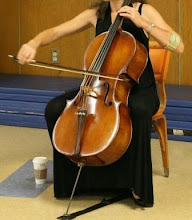
I cannot remember a time when I didn’t live and breathe to musical accompaniment. I would love to say that I was simply born with music in my soul, but my mother is a pianist and piano teacher, and I imagine I spent my time in the womb sucking my thumb as I listened to Chopin, as close to the piano keys as an unborn child can be.  Throughout my childhood, our house was home to a never-ending performance: my mother’s piano, my father’s recorder, my piano and cello, my brother’s violin.  When no one was practicing or teaching, recorded music was piped through speakers throughout the first floor.  To this day I enter the kitchen, or walk into my classroom, and reach for my iPod, searching for just the right accompaniment to my mood.  In moments of relative quiet, with no live music, iPod or radio nearby, my head takes over, providing me with its own internal soundtrack.  I wake up each morning with a melody in my head, and go about my day wondering which phrase or bit will next accompany me on my travels. 

As a child, I remember framing my personal soundtrack in the supremely egocentric and dramatic format of an autobiographical movie.  I watched myself live on the large screen, and narrated my actions and thoughts silently, in the third person. 

Scene: Girl’s bedroom, circa 1972.  Cue soft strains of Simon and Garfunkel’s “Sounds of Silence:”  

Narrator:  “She emerges from under the covers after hours of reading in the dark, turns off her flashlight, and spends hours lying awake, staring at the floor and trying to convince herself that the soft patch of light from the street lamp outside is not hot, and will not burst into flames.”

I may no longer imagine my life on the big screen, (though one could safely argue that writing this blog is just as self-absorbed as narrating my relatively uneventful childhood in the third person).  But my soundtrack is still with me, reflecting my moods and shaping my thoughts, day in and day out. 

This morning I woke up to the Gavotte from Bach’s Sixth Cello suite in my head.  It is a spritely and playful piece, but today it felt and sounded fractious and intrusive, as if played by a small child on a shrill violin.  My mood was cranky and irritable: I had a headache, needed caffeine, and was hung-over from a long rehearsal and a rather large celebratory glass of port after the Health Care Bill passed.  The strident Gavotte fit my fractured mood, and nourished it well past the restorative coffee and Advil.  The bits and pieces on my soundtrack have shifted throughout the day: part of Saint-Saens’ Third Symphony crept in while I scrubbed potatoes; Rimsky-Korsakov’s Russian Easter kept time as I folded laundry; I craved and found Andrew Bird’s “Oh No” on my iPod to soothe me as I cleaned up the breakfast dishes.   As eclectic and varied as these pieces are, they all reflected facets of my mood, their presence as comforting and nurturing as an empathetic friend.

The soundtrack library of my brain is my personal history: each piece has been culled from forty-six years of listening and playing.  When a song first speaks to me, I explore it, looking for its moments of wonder and grace. I play it over and over, unraveling the layers and committing them to memory.  (This habit of playing of favorite songs over and over caused my poor parents much anguish, particularly when I expanded my repertoire to include music written after 1940.  They still cringe when they hear the sounds of “Bye, Bye, Miss American Pie.”)    Playing in an orchestra, I am regularly forced to dissect musical creatures that are not of my choosing, de-feathering and deboning until they are laid bare.  Sometimes I am surprised by what lies underneath: there are pieces of music that I come to love only after deconstructing them to their simplest elements (Ravel’s Piano Concerto for the left hand).  Other times I am disappointed: though I love Tchaikovsky, it only took me one rehearsal to conclude he probably should have thrown out his first symphony with the proverbial first pancake.  Unfortunately, once I have practiced and played a piece, it becomes part of my permanent soundtrack repertoire whether I like it or not, ready to be burped up into my brain without a moment’s notice.

One of the nice things about being married to a musician is that you can ask, “So what voices do you have going through your head right now?” and know that you will not be driven to the nearest mental health facility in search of treatment.  Larry says he does not have the continual soundtrack I do (I allow that the extent to which my brain sings is somewhat extreme), but he can relate, and often trade tunes with me.  During the week before an orchestra concert, we spend hours in dress rehearsals, going over and over our music.  Usually for several days after the performance, we cannot get various tunes and phrases out of our heads.  “Guess which piece I’m stuck with right now!” is a typical conversation starter, and we joke by singing certain intrusive passages in each other’s ears like insistent mosquitoes until one of us cries, “Stop!”

Soundtrack companionship also has its humorous moments.  I remember well one romantic night in bed; candles, lingerie, background music from our local classical radio station.  Just as events picked up speed, the radio began playing Brahms’ Hungarian Dance #5.  The rhythm, intensity and somewhat clichéd drama of the music synced so perfectly with the action that it became suddenly wildly ridiculous to both of us, and we burst out laughing in unison, Larry collapsed on top of me, with tears running down our faces.

There are moments of pure joy in my daily soundtrack that I cannot capture in words.  I’ve tried to put them in a poem, but end up tossing cliché-riddled lines aside in frustration.  It’s a moment of musical synchronicity: when the shape of the melody and the blending of the harmonies and the rhythm merge into something magical.  I am able to find one such moment today, even in all my irritable crankiness, as I listen to Bach’s Chaconne for Violin from Partita #2.  The song in my head ruptures free, and bleeds into my soul.  It is a moment of joy and of grace and of wonder, and I cannot imagine my world without it.