Monday, March 22, 2010

Soundtrack


My life has a soundtrack. 

This used to concern me; I worried the roots were pathological – a type of musical schizophrenia.  But while schizophrenics hear voices in their heads, I hear melodies, harmonies, bits and pieces of sonatas and symphonies.  I cannot choose the music – it travels in and out of my head as dreams and nightmares do; connected to my state of mind, but not sensitive to my wishes.

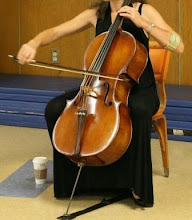
I cannot remember a time when I didn’t live and breathe to musical accompaniment. I would love to say that I was simply born with music in my soul, but my mother is a pianist and piano teacher, and I imagine I spent my time in the womb sucking my thumb as I listened to Chopin, as close to the piano keys as an unborn child can be.  Throughout my childhood, our house was home to a never-ending performance: my mother’s piano, my father’s recorder, my piano and cello, my brother’s violin.  When no one was practicing or teaching, recorded music was piped through speakers throughout the first floor.  To this day I enter the kitchen, or walk into my classroom, and reach for my iPod, searching for just the right accompaniment to my mood.  In moments of relative quiet, with no live music, iPod or radio nearby, my head takes over, providing me with its own internal soundtrack.  I wake up each morning with a melody in my head, and go about my day wondering which phrase or bit will next accompany me on my travels. 

As a child, I remember framing my personal soundtrack in the supremely egocentric and dramatic format of an autobiographical movie.  I watched myself live on the large screen, and narrated my actions and thoughts silently, in the third person. 

Scene: Girl’s bedroom, circa 1972.  Cue soft strains of Simon and Garfunkel’s “Sounds of Silence:”  

Narrator:  “She emerges from under the covers after hours of reading in the dark, turns off her flashlight, and spends hours lying awake, staring at the floor and trying to convince herself that the soft patch of light from the street lamp outside is not hot, and will not burst into flames.”

I may no longer imagine my life on the big screen, (though one could safely argue that writing this blog is just as self-absorbed as narrating my relatively uneventful childhood in the third person).  But my soundtrack is still with me, reflecting my moods and shaping my thoughts, day in and day out. 

This morning I woke up to the Gavotte from Bach’s Sixth Cello suite in my head.  It is a spritely and playful piece, but today it felt and sounded fractious and intrusive, as if played by a small child on a shrill violin.  My mood was cranky and irritable: I had a headache, needed caffeine, and was hung-over from a long rehearsal and a rather large celebratory glass of port after the Health Care Bill passed.  The strident Gavotte fit my fractured mood, and nourished it well past the restorative coffee and Advil.  The bits and pieces on my soundtrack have shifted throughout the day: part of Saint-Saens’ Third Symphony crept in while I scrubbed potatoes; Rimsky-Korsakov’s Russian Easter kept time as I folded laundry; I craved and found Andrew Bird’s “Oh No” on my iPod to soothe me as I cleaned up the breakfast dishes.   As eclectic and varied as these pieces are, they all reflected facets of my mood, their presence as comforting and nurturing as an empathetic friend.

The soundtrack library of my brain is my personal history: each piece has been culled from forty-six years of listening and playing.  When a song first speaks to me, I explore it, looking for its moments of wonder and grace. I play it over and over, unraveling the layers and committing them to memory.  (This habit of playing of favorite songs over and over caused my poor parents much anguish, particularly when I expanded my repertoire to include music written after 1940.  They still cringe when they hear the sounds of “Bye, Bye, Miss American Pie.”)    Playing in an orchestra, I am regularly forced to dissect musical creatures that are not of my choosing, de-feathering and deboning until they are laid bare.  Sometimes I am surprised by what lies underneath: there are pieces of music that I come to love only after deconstructing them to their simplest elements (Ravel’s Piano Concerto for the left hand).  Other times I am disappointed: though I love Tchaikovsky, it only took me one rehearsal to conclude he probably should have thrown out his first symphony with the proverbial first pancake.  Unfortunately, once I have practiced and played a piece, it becomes part of my permanent soundtrack repertoire whether I like it or not, ready to be burped up into my brain without a moment’s notice.

One of the nice things about being married to a musician is that you can ask, “So what voices do you have going through your head right now?” and know that you will not be driven to the nearest mental health facility in search of treatment.  Larry says he does not have the continual soundtrack I do (I allow that the extent to which my brain sings is somewhat extreme), but he can relate, and often trade tunes with me.  During the week before an orchestra concert, we spend hours in dress rehearsals, going over and over our music.  Usually for several days after the performance, we cannot get various tunes and phrases out of our heads.  “Guess which piece I’m stuck with right now!” is a typical conversation starter, and we joke by singing certain intrusive passages in each other’s ears like insistent mosquitoes until one of us cries, “Stop!”

Soundtrack companionship also has its humorous moments.  I remember well one romantic night in bed; candles, lingerie, background music from our local classical radio station.  Just as events picked up speed, the radio began playing Brahms’ Hungarian Dance #5.  The rhythm, intensity and somewhat clichéd drama of the music synced so perfectly with the action that it became suddenly wildly ridiculous to both of us, and we burst out laughing in unison, Larry collapsed on top of me, with tears running down our faces.

There are moments of pure joy in my daily soundtrack that I cannot capture in words.  I’ve tried to put them in a poem, but end up tossing cliché-riddled lines aside in frustration.  It’s a moment of musical synchronicity: when the shape of the melody and the blending of the harmonies and the rhythm merge into something magical.  I am able to find one such moment today, even in all my irritable crankiness, as I listen to Bach’s Chaconne for Violin from Partita #2.  The song in my head ruptures free, and bleeds into my soul.  It is a moment of joy and of grace and of wonder, and I cannot imagine my world without it. 

Saturday, March 13, 2010

Mean Girls


I have a confession to make.  A couple of weeks ago, I acted like a Mean Girl. 

I had been discussing one friend with another, and we had agreed that a certain trait of hers bothered both of us.  Now in my mind, this in itself is not a Mean Girl act.  We weren’t calling the mutual friend names, we weren’t making fun of her, or saying we didn’t like her – we were simply agreeing that we both found this particular quirk of her personality hard to take.  The act of two people agreeing that a third person can be hard to take is not a Mean Girl act.  It is a conversation that happens all over the world, all the time, and throughout time.  It is a conversation between parents regarding a daughter, daughters regarding a parent, colleagues regarding a boss, students regarding a teacher, prostitutes regarding a senator…  it’s human, and it isn’t mean.

I became a Mean Girl when I made a snide, in-the-know reference to this mutual friend’s behavior on my friend’s Facebook page.  Once it became a joke at her expense, and behind her back, it became something else.  I was, at that moment, being unkind.

The next day at work, my friend, referring to my snide post, remarked, “I didn’t know you were a Mean Girl!”  I was slightly taken aback, but figured I deserved it.  What I said was meant to be funny, and to make her laugh, but was snarky, and it made me uncomfortable to think of it in that light.

The reality is that we are all capable of being nasty at someone’s expense, and I imagine there are very few of us in this world who don’t resort to it at one time or another.  Turning someone else’s irritating behavior into an excuse for shared humor with a friend not only helps relieve some of the frustration; it solidifies your relationship with the friend, which thrives on the shared experience.  

But the fact that we all do it doesn’t make it right.

I used to belong to an Internet forum for parents of twins.  Actually, the forum was open to a larger community: twins themselves, relatives of twins, those who had lost a twin, or were expecting twins.  I had never thought of myself as the type to join a group about anything – I am not, by nature, a “joiner,” and my tolerance for belonging to large groups of people is low.   But I was thirty weeks pregnant, had just topped 200 pounds, and had been relegated from my job as a teacher to lying supine on my living room sofa.  The Internet was a necessary diversion from too many Discovery Channel movies about traumatic births, and an overdose of novels.  Voila, here was a virtual “room” filled with people – most of them women - who were either lying on the sofa like me, or dragging themselves about exhausted, dealing with multiple infants and children.

So I happily read and responded to posts in the Expecting Forum, avidly drinking in all the birth stories and doctors visits. I frequented the “Corn,” a more restricted site where conversations turned away from parenting to more topical and even controversial issues, and the debate was vigorous, often interesting, and occasionally dramatic.  Debates raged over politics, current events, religion, science; arguments got occasionally heated, but were rarely dull.

I was intrigued by the diversity of opinions on the forum, which was made up of women (and a few men) from a variety of backgrounds, religious beliefs, and areas of the world.  How fascinating to see where the commonalities are, and where the differences lie! I developed respect and admiration for a number of people: those who could argue a point of view eloquently, those who weren’t afraid to be the one opposing voice on an issue, those who were willing to share their thoughts openly.  Those who, even when arguments got particularly volatile, could keep their anger to the issue at hand, and not degenerate into name-calling and other disrespectful verbal attacks.  I admired Cathy, a scientist by both nature and profession, who would fight an anti-evolution argument tooth and nail, but always keep her manners about her.  And Renée, who wrote beautifully, with such spirit and wisdom and knowledge, and could not be intimidated from defending her point of view.  Carolyn Ann – a twin himself, and one of the few men on the board, was often intimidating in his intelligence and the way he attached himself to an argument like a bulldog on an old sneaker, and exasperated me virtually to tears when I disagreed with him, but he became one of my favorite posters for his intellect, passion and perceptiveness.  Despite frequently contrasting views on issues, Cathy, Reneé and Carolyn Ann shared an essential humanity: they knew how to keep a discussion politic, and not personal.  No name-calling, no backstabbing, no excluding or attacking someone personally.  When the discussion ended, no matter how passionate (or even sanctimonious) the posts became, the respect and the shared humanity were still there.

I participated in the twin forum for about three years: from those initial weeks on bed rest through the spring before Rachael and Chloe’s third birthday.  I still look back on those early days fondly: for a non-joiner, it was a successful “joining.”  It got me writing again, and I ended up adding a blog to the forum, and challenged myself to share my thoughts and experiences.  As an atheist who really hadn’t examined her beliefs too closely in years, I explored the religions and philosophies of other members, and was able to define my own beliefs more clearly as I understood and appreciated theirs.

Over time, however, I found myself becoming increasingly disillusioned with the direction the forum was taking.  I was irritated at the number of topics that cycled over and over, and degenerated into the same vituperative arguments each time.  I became aware that there were cliques of members ganging up on those they didn’t like or agree with. Some moderators worked hard to keep things both respectful and interesting: others seemed to be fonder of slapping certain members on the wrist for strong opinions.  Name calling, exclusion, backbiting: it all began to smell like junior high school, and I no longer had the desire to be there.  I was reminded that Mean Girls grow up, and that we often hold on to patterns of social behavior that are not so pretty.

Carolyn Ann left after being called a murderer for his pro-choice stance.  Renée, who seemed to know how to take regular breaks from the forum to pace herself emotionally, was on another break, and I missed her wisdom.  Cathy, tired of arguing the existence of dinosaurs to anti-evolutionists, gave up on the Corn.  Others I respected continued to participate, but I found myself too frustrated to continue, and quietly bowed out.   I’m sure my conclusions at the time were irritatingly sanctimonious, but whatever the experience had become, it no longer worked for me.  “If you can’t join ‘em, leave ‘em,” I decided, and I worked to push the whole experience out of my mind.

Last month I received an email from a member of the twin forum – one I had not known well, but had respected.  Some former members had started a new forum: by invitation only.  By inviting participants they felt would contribute productively, they could build a forum that would allow members greater freedom to express themselves, with fewer rules and less control by the moderators.  In addition to the twin aspect, many of the members were atheists, and shared thoughts about religion and society that resonated for me.

It took me a few days to decide to join – I no longer missed the other forum, and truly didn’t have the time for something new.  But, flattered, I ultimately decided to participate, and looked eagerly through the boards and topics, surprised at how pleased I was to see various names I remembered and respected from the old days.  Slowly I began to work my way back in to the routine, re-learning the posting and formatting, the quoting and the linking.  I was so please to see Renée on board, and to reconnect with other members as well.  A provocative quote from the blog of another member I respected (Anne: “If the desire to write is not accompanied by actual writing, then the desire must be not to write.” Hugh Prather) got me thinking about writing again, and I once again began blogging as well.

As I searched through the boards to familiarize myself with the lay of the land, I began to fill in some of the blanks.  This new spinoff forum, I learned, came about as a result of dissatisfaction with the other twin forum.  Clearly, there was a lot of upset and anger over situations and arguments that had happened over there, and a lot of unhappiness with many members.  I attributed the proliferation of angry comments, snide remarks, and multiple put-downs directed at certain members of the “other” board, to a situation that I could not understand: I wasn’t there, and it wasn’t fair for me to judge either the level of anger or its method of release.

But over time, it has grown to bother me more and more.  Interesting and provocative topics are often ignored in favor of multiple pages of rants and complaints about people, and mocking paragraphs about their opinions and beliefs.  There are members who work hard to keep the forum interesting, and who post intriguing topics for discussion.  But I feel too much of the energy and spirit of the board is devoted to angry responses to posts and people on the “other” twin board.  I’m sure that each and every one of the members on the board would look in the mirror, and believe that they have every reason to complain and be angry.  But to this outsider, the tenor of this forum has become every bit as uncomfortable as the other one: just in a different way. 

We are all Mean Girls at times.  I have resorted to muttering unkind comments about a colleague, and then felt uncomfortable about it afterwards, knowing that I have crossed a line by possibly skewing someone else’s perception of the colleague in the process.  Larry and I leave orchestra rehearsals each week frustrated and disillusioned, and spend the drive home (and hours afterwards) criticizing our conductor: a process which quickly degenerates into gratuitous snarkiness, yet somehow, doesn’t feel like it crosses a line.  Is it because our anger remains with the two of us?  If we share it with one friend, or group of friends in the orchestra, does it become unfair?  Or is it only unfair if it is shared with those who might not agree with us?

 I don’t have answers, but I’d like to believe that as adults, we try to draw the line so that our frustrations get shared and our anger gets vented without losing our respect for each other in the process.


Friday, March 5, 2010

Babies Having Babies


Scene: The dinner table.  
Characters: Rachael, Chloe, Mommy and Daddy.  Gretchen missed this one due to ballet class, unfortunately.

Chloe: “Mommy, I want a new baby, now.  When can I get a new baby?”

Rachael: “Yeah, when can we each get a new baby?”

Mommy:  “Not for a long time, not until you grow up.  Then you can have a baby of your own.”

Chloe: “But I want a new baby now.  Please can you get me one now?”

Mommy: “I can’t get you a baby, Chloe.  Mommy’s too old.  I can’t have babies any more.”

Daddy: “You guys are the end of the line.  No more babies.”

Rachael (frowning): “What is the end of the line?”

Daddy: “It means you are the last two.  No more of you.”

Chloe: “Well, I want a baby now.  Please get it for me.”

Mommy: “You’re going to have to wait until you grow up for one.  Then you can have a baby of your own.”

Chloe: “I don’t want to have one.  I want you to get it for me.”

Mommy: “Why don’t you want to have one of your own?”

Chloe: “Because I don’t want them to cut me open and take it out.  So you have to do it for me.”

Rachael: “I want one too.  Hey, I have an idea, Chloe!  Mommy can have a baby and give it to me, and Daddy can have a baby and give it to you!”

Chloe: “Yes, you can each give us a baby!  Mommy will give hers to me, and Daddy can give his to Rachael!”

Rachael: “No, I want Mommy to give hers to me, and Daddy to give his to you, Chloe.”

(Argument ensues about which parent will have which baby to give to which twin.  Mother distracts with question.)

Mommy: “Can Daddies have babies?”

Chloe: “Yes!”

Mommy:  “All by themselves?  Can they carry them in their tummies?

Chloe: “Yes! No, I mean.  I forgot.  I think… you have to help him.”

Rachael: (frowning) “How come you can’t each have one?”

Mommy: “You need a mommy and a daddy to make a baby.” 

(Note: This Mommy apologizes for the politically and socially incorrect explanation.  She will ultimately make it clear that babies can be made many ways, and that two mommies can have a baby, and two daddies can have a baby – Just like your friend Natalie, girls! – and daddies can even wear dresses and still make babies and be daddies.  Mommies can even become daddies, and still have babies.  And Mommies can use turkey basters – like the one we use when we roast chickens. This Mommy just needs to start with the concrete family-to-self-connection thing first.  Baby steps. ;-))

Rachael:  “How does that work again?  I forgot.  There’s an egg, and… and…”

Mommy: “A sperm.”

Rachael: “That’s it – a sperm.  (frowns)  How does the sperm get in the egg again?”

Mommy: “It comes out of the Daddy’s penis—“

Chloe (interrupting): “Oh no.  Not that word.  I don’t want to hear that word.  Don’t say that part.”

Mommy: “Why?”

Chloe: “Because I already know that.  I don’t want to hear that word.”

Mommy (ignoring Chloe and turning to Rachael): “The sperm goes from the Daddy’s penis into the Mommy’s vagina, and then finds an egg and goes in it.  Then it grows into a baby.  When you grow up, you can choose to have a baby.”

Rachael (still frowning): “But I don’t want to be cut open.”

Mommy: “Not everybody gets cut open when they have a baby.  I wasn’t cut open when Anna, Ian or Gretchen was born.  I had to be cut open when you were born because there were two of you, and you were really, really big.”

Rachael: “Oh. (relieved)  (then frowns again) “Where does the baby come out again if you aren’t cut open?”

Chloe: “Oh, I know!  Where you go pee.”

Mommy: “Well, actually, it’s just behind where you go pee, in your vagina-“

Chloe: (interrupting) ““Oh no.  Not that word.  I don’t want to hear that word.  Don’t say that part.  Don’t say that vagina word.  I already know that word.”

Rachael: (frowning – goodness, is she always frowning?) “Does it hurt?”

Mommy: “Yes, but then when it’s all done, it stops hurting.”

Rachael: “What does it feel like?”

Mommy: (thoughtful pause)  “It feels like having a really, really big poop.”

(Daddy chokes on his dinner.  Girls dissolve into shrieks of laughter.)  “Mommy said a bathroom word at the dinner table!  Mommy said “Poopy!  Poopy, poop, poop…”

(Time to do the dishes.)

Saturday, February 27, 2010

The Tree Doesn't Fall Far from the Car

“If you find it hard to laugh at yourself, I would be happy to do it for you.  - Groucho Marx


In my opinion, there are items necessary for survival, and then there are items necessary for sanity.  We pretty much share the survival items as a species: food, water, shelter and procreation.   The things we need for our individual sanity are more a reflection of our personalities, and while there’s overlap, we can each give or take a few.  My items of sanity (their order of importance waxes and wanes with the time of the month): music, books, chocolate, coffee, sarcasm, irony, banter, cynicism, satire, and sex.

Note: for those grown-up children of mine who might secretly be lurking on this blog – don’t worry – I’m not going to talk about the sex part.  Since there are five of you in all, one might argue that I took the procreation part a little too seriously, but then again, I truly didn’t count on getting two for the price of one at the tail end of it all.

No, today I’m thinking about sarcasm and its close relatives; irony, banter, cynicism and satire.

Actually, to be honest, I think about sarcasm most days.  I view the world through a lens of irony, banter facetiously, speak with a sarcastic overtone, act satirically, and listen with cynical ears.  Hell, I’ve even been known to play music with a sarcastic tone when the music is predictable, sappy or clichéd (i.e. John Williams).  Photoshop is my god of visual sarcasm: just the other night I spent way too many hours arranging my conductor’s face on an image of a Napoleon costume and posting it to my profile.  And my eyes – well, my mother used to warn me that my eyes would get stuck – rolling like that all the time.  Perhaps if they had, the next generation wouldn’t have refined the eye-roll to quite the art they have in retaliation.

My sarcastic nature is part of an overarching cynicism; a general suspicion about the world, and towards those of us who inhabit it.  I find biting humor and a blackly funny outlook necessary for sanity in a world that is often sad, and frequently ridiculous.  After all, if you anticipate the appearance of the dark side, you can’t be as disappointed when it arrives.  Which leaves you free to enjoy the humor of it all, by cutting it open with a sharply worded scalpel, and eviscerating the contents, piece after rotten piece.

Larry and I herald the frequent appearance of the dark side as “the tree falling on the car.”  This inside joke refers to an episode that took place thirteen or so years ago, when I was teaching preschool.  It was a windy, blustery spring day.  My car was parked in the parking lot behind the school – one of about twenty cars in the lot.  As we teachers stood shivering in the wind on the playground, watching the students run about and swing, a large gust of wind blew through, and we heard a giant cracking sound coming from the yard next to the school.  We watched incredulously as an enormous old maple – the kind with a trunk about three feet in diameter – proceeded to topple over the fence and into the parking lot.  Though our view of the parking lot was blocked by a number of trees, I was absolutely certain of the outcome.

“That tree just landed on my car.” I said, calmly. 

We walked through the playground and to the parking lot to see my Mercury Villager minivan completely crushed under the weight of the giant tree.  The cars parked on either side of me were, of course, completely unscathed. 

Now I do realize that there is nothing overtly ironic about a tree falling on a car.  It was a major, but straightforward annoyance.  And if I were one of those people who view the world optimistically, - a (gasp in horror) Positive Thinker - I could congratulate myself on the wonderful news that no one was in the car at the time the tree fell.  I could even, if I were a religious fundamentalist, be deluded into congratulating myself on saving my family from Death By Tree by embracing an almighty god, and tithing to his one and only church. 

But I truly believe that the potential irony of any given catastrophe is dependent upon one’s reaction to it.  I fully expect the tree to fall on my car, and plan my response accordingly, digging and sifting through the event for irony, sarcasm, and black humor when and wherever I can find it.

In this particular situation, the irony was in the details: of the twenty cars in the parking lot, nineteen were gleaming, foreign automobiles, mostly luxury models, dent and scratch free.  They belonged to the school’s upper class mothers, and a few teachers who began as upper class mothers and became teachers in order to maximize the amount of time they could spend hovering over their children.  I was the sole outlier: my secondhand minivan, with seventy-five thousand miles on it, bore the evidence of three small children.  The car was vibrantly decorated with chalk drawings and wobbly signatures, and the sides were covered with dents and scratches from madcap tricycle races in the driveway.   I was not in a position to afford the deductible on the car, much less new wheels.  That the enormous old tree picked my car to fall on was an example of situational irony that did not escape me at the time, and became the standard by which all other bleakly humorous episodes would be judged.

Sometimes, the falling tree is on the smaller side - small enough that the noise from its fall would be easy to miss, if you weren’t looking for it.  Just today, one of the passenger doors on my car (a Honda Pilot replaced the Villager) became mysteriously and permanently locked.  It will not open from the inside or the outside.  The Right-Side-Of-The-Car twin, Chloe, cannot be removed, or ejected from the vehicle, without crawling over the trash can, ten empty Peets coffee cups rolling around on the floor, and a giant book bin.

On the rear of my car, I have a bumper sticker that reads, “Honk if the twins fall out.”

And sometimes, the tree is so large that it could pass for a Giant Sequoia. 

Five years ago, I married a man who had no biological children of his own, and thought he might want one.  I, on the other hand, was long done with procreation, and perfectly happy with the three teenagers I had.  But I loved Larry dearly, and the desire to share something this important to him was strong. After seventeen years of child rearing and twenty years of teaching, I figured I had this parenting thing down.  “Hell, what’s one more?” I asked myself.   I reasoned to myself that the triple threat of a 42 year-old woman, a 51 year-old man, and no medical intervention wasn’t a particularly dangerous combination.  Why overanalyze the wisdom of an outcome not likely to transpire?

A whopping eight weeks after our wedding, I found myself lying on an examination table, my shirt tucked up under my arms, and my belly covered with goo.  Larry sat in a chair next to me, holding my hand.  An ultrasound technician, waving her magic wand over my abdomen, turned to my husband and said, “It’s a good thing you’re sitting down.” 

It’s been just over five years since that day, and four years and eight months since the twins were born.  Larry hasn’t sat down since.

Thursday, February 11, 2010

The Quiet Before You Speak


The quiet before you speak


is distinct - how do I know it from silence?

I stand at the mirror, holding my brush, suspended;
you sit on the edge of the bed, putting on your shoes.
Is it your breath; held, then drawn in abruptly?
A caesura, a muted exhale,
repeat.
You are composing.
If I ask, you will say Nothing and the moment will be gone.

Knowing the quiet
and waiting
is what we give each other.

Friday, February 5, 2010

Tiptoe

The shoes arrived each year in late August. 

They were a stiff, rich red leather; lace-ups with a rigid brown sole.  Out of the box they shone a glossy red that distinguished them somewhat from the brown school shoes worn by boys, though they were a far cry from feminine, shiny black Mary Janes.

The shoe salesman would put them on and lace them up, pressing firmly against the stiff leather to locate my toes underneath, before pronouncing them “just right.” They were new and un-scuffed, and for a brief moment I took pleasure in them; the moment until I was asked to get up and take a walk through the store.

I am, and have been since I took my first wobbly steps at 19 months of age, a congenital toe walker.  Putting my heels to the ground is uncomfortable, and sometimes, particularly first thing in the morning, undoable.  I am happiest up on my toes, and though I make a concerted effort to walk “normally” out in the world, the minute I open the door and walk into my house each afternoon, I let down my guard, and grow an inch or two. 

I was born with Achilles tendons that were too short, and learned to ride a tricycle before I was able to comfortably navigate the world upright.   At the age of three I was taken to see a pediatric orthopedic surgeon, who watched me toe my way up and down a mirrored hallway, and recommended prescription footwear that would force my heels to remain on the ground.  The shoes, special-ordered from New York each year and sent to our local shoe store for fitting, were stiff and unforgiving.   The backs of my legs pulled and ached as if there were thick rubber bands stretched tightly down the back of the calves. At night I would wake up with terrible cramps in my calves, and howl for my parents to come “pull them out.”

Out and about in the neighborhood, where I was allowed the blissful comfort and flexibility of sneakers, I ran, jumped and played happily on my toes.  Like many a first child I was socially naïve, and without the brutal honesty of older siblings to set me straight, I was unaware of how I looked.   Somewhere around the age of five, (aided and abetted by Tiny Tim’s timely hit single, “Tiptoe Through The Tulips,”) I began to understand that I was being teased.  Neighborhood kids began taunting me with the song, sung in falsetto with air ukulele accompaniment.  I was bewildered and surprised, but eventually understood I had little choice but to laugh, and pretend I didn’t care.

For my tenth birthday, I was allowed to give up the red orthopedic shoes in exchange for a promise to do special stretching exercises every night.  The stretches hurt, and as happens with most childhood promises, I soon broke mine.  My parents tired of nagging me, and I was back on my toes again within a short time.

My heels were brought back down to the ground when I was twelve or so by the mid-seventies craze for Earth shoes.  A company called Roots was manufacturing a clunky suede shoe with a “negative heel,” and it had suddenly taken on (like many Seventies fashions) an inexplicable popularity.  One cold February weekend I was firmly escorted by my parents (who were somewhat more embarrassed about my gait than I was) through Harvard Square to the Roots Store to get my first pair.  The whole family left the store sporting Roots shoes, an unusually fashion-forward display of solidarity.

Ah, to be a teenager in Earth Shoes – a girl, at that!  In a brief period of time, the shoes were passé, and I looked nothing short of ridiculous.  I clomped awkwardly through junior high school dressed in boy’s jeans, flannel shirts, my hair cut very short (think Sandy Duncan in Peter Pan), and my Roots.  Occasionally, a group of girls would saunter by in the hallway and ask snidely (and somewhat curiously), “Are you supposed to be a girl, or a boy?”  Surprised by the question, I began to wonder just what I looked like to the rest of the world.  In the afternoons, while my mother taught piano lessons downstairs, I stole into my parents’ bedroom, and explored my mother’s mirrors, and the top drawer of her dresser, with its creams, compacts and lipsticks.  The Roots were eventually pushed to the back of the closet, and I grew out my hair. I became more conscious of my walk, and worked hard to keep my heels on the ground.

At some point in my adult life (I don’t remember exactly when), I discovered the magic of heels.  Once found, I bought and wore them with the surreptitious desire of an addict; pushing aside the knowledge that heels are, like too much alcohol or cigarettes, bad for me.  In heels, I (almost) walk like a normal person.  In heels, I walk in comfort.  The wonderful sensation of the ground under my toes!  With a satisfying click, click, I can be comfortable, and even a touch feminine.  Once the shoes come off I an unable to drop my heels to the floor, but it seems a worthwhile price to pay. 

In flats, by contrast, I feel ungainly, awkward, squat, and genderless.  In flat shoes, I am regularly accosted by colleagues, parents of students, and even slight acquaintances, who look concerned and ask, “Are you hurt?  Is something wrong?  You look like you’re limping.”  Used to variations of this question over the years, I reply breezily and self-deprecatingly,  “Nah, I’m fine – that’s just the way I walk.”  But as I trot unevenly out of view, I make that extra effort to put each heel down first.

Five years ago, as a result of carrying and giving birth to enormous twin girls at an advanced age, I developed a number of serious complications and spent six weeks in the hospital.  During this time my feet rested neglected, in ballet-perfect points, at the foot of the bed.  My resulting “foot drop” was so severe that when I was finally hoisted to my feet, and told to walk, I was completely unable to get either heel on the ground.  I limped around the floor of the hospital ward on my toes, gripping a geriatric walker on wheels while dragging an oxygen tank in my wake.

Time heals most wounds, and as the twins careen towards their fifth birthday, I am healthy and happy.  With the exception of a sensitive stomach and pronounced “muffin top,” I am pretty much recovered from the whole double childbirth experience.  I’m embarrassed to admit that my feet, however, are not.  Each morning I get out of bed and limp around for a good half-hour before I can get my left foot fully on the floor.  I put heels on with a sense of relief each day; relief tinged with the discomfort of one who knows she has developed a bad habit she needs to break, and just can’t bring herself to do it.

That is, until just recently. 

While leafing happily through magazines a few weeks ago, I discovered that Earth Shoes have come back into vogue.  That very same “negative heel” that made them so popular back in the Seventies is back, in a wider range of fashionably more acceptable styles.  Such richness compared to the tan suede, crepe-soled Roots of the Seventies!  There are the “Exer-Fit” sneakers (you’ll burn up to four times the calories while walking! claim the ads), there are clogs: fur lined and bare, and “Exer-Flip” flip-flops for summer wear.  I search eagerly through the choices online, wondering if this new batch of orthopedic footwear holds a pair just for me: one that will, almost 43 years after the first pair, get me back on my feet.

And then I find them.  Shiny, burgundy red leather shoes.